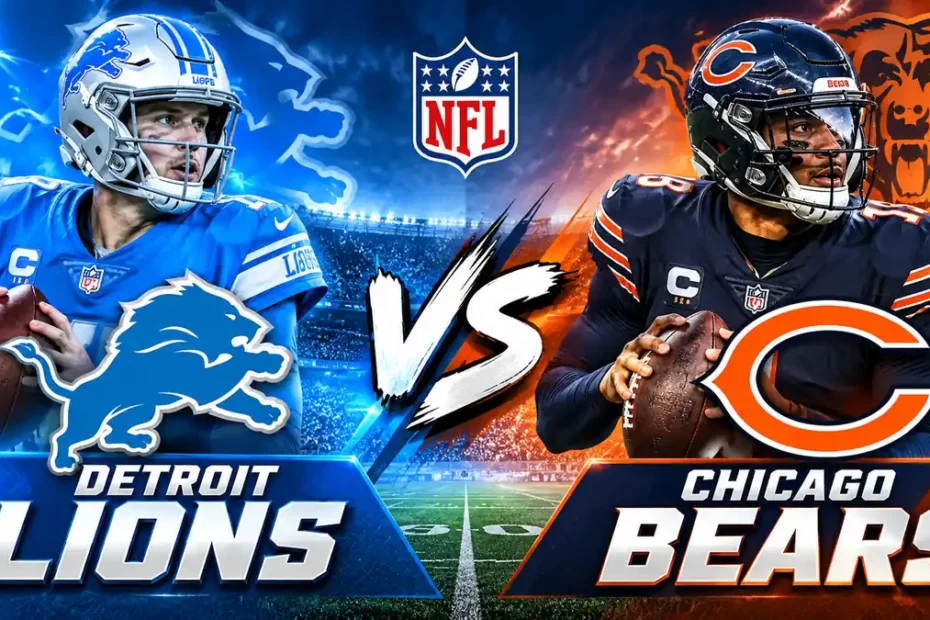
The Detroit Lions vs Chicago Bears rivalry delivered a statement performance at Ford Field, where Jared Goff produced a near-perfect passing display to dismantle Chicago’s defense. Detroit’s offense found the end zone on seven occasions, exposing structural flaws in the Bears’ coverage schemes and run defense. The final score of 52-21 reflected a lopsided contest in which the Lions accumulated 511 total yards and controlled possession for over 30 minutes .
The game, played on September 14, 2025, in front of a home crowd at Ford Field, was decided early. Detroit scored on its opening possession and never relinquished control, building a 28-14 halftime lead before pulling away with a 10-point third quarter. Goff finished with five touchdowns and a 156.0 passer rating, while Chicago’s Caleb Williams struggled to generate consistent rhythm against a disciplined Detroit pass rush that recorded four sacks .
Match Overview Table
| Information | Match Details |
| Event | NFL Regular Season |
| Game | Detroit Lions vs Chicago Bears |
| Date | September 14, 2025 |
| Venue | Ford Field, Detroit, Michigan |
| Attendance | Not specified in available sources |
| Winner | Detroit Lions |
| Final Score | 52-21 |
| Broadcast | Not specified in available sources |
Core Match Statistics Overview
| Metric | Detroit Lions | Chicago Bears |
| Total Yards | 511 | 339 |
| Passing Yards | 334 | 205 |
| Rushing Yards | 177 | 134 |
| First Downs | 25 | 19 |
| Yards per Play | 8.8 | 5.3 |
| Turnovers | 0 | 2 |
| Sacks Allowed | 0 | 4 |
| Red Zone Efficiency | 6-7 (85.7%) | 2-2 (100%) |
| Possession Time | 30:20 | 29:40 |
Passing Efficiency and Explosive Plays
- Goff averaged 11.9 yards per pass attempt, a figure that reflects both clean protection and Chicago’s inability to contest intermediate routes .
- The Bears allowed four sacks and generated zero quarterback hits of consequence, failing to disrupt Detroit’s timing.
Turnover Margin and Red Zone Execution
- Detroit converted six of seven red-zone opportunities into touchdowns, while Chicago’s two red-zone trips both ended in scores but occurred too infrequently to matter .
- The Lions forced two turnovers—a Brian Branch forced fumble and a Kerby Joseph interception—and turned both into points .
Ground Game Complementarity
- Jahmyr Gibbs rushed for 94 yards on 12 carries, and David Montgomery added a short touchdown, giving Detroit a two-headed rushing attack that averaged 5.9 yards per attempt .
- Chicago’s 5.0 yards per rush was respectable but irrelevant once the game script forced Williams into obvious passing situations.
Period-by-Period Analysis
First Quarter
| Team | Points |
| Detroit | 14 |
| Chicago | 7 |
Detroit opened with a methodical drive capped by Gibbs’ 6-yard touchdown run, setting an immediate tone of physical dominance .- Chicago responded through Rome Odunze’s 28-yard touchdown reception, briefly suggesting a shootout.
- Detroit reclaimed control on Montgomery’s 1-yard plunge, exploiting Chicago’s interior defensive line.
Second Quarter
| Team | Points |
| Detroit | 14 |
| Chicago | 7 |
Goff found Brock Wright and Amon-Ra St. Brown for short touchdowns, both coming on plays where Chicago’s linebackers failed to carry vertical threats .- A diving one-handed catch by rookie Isaac TeSlaa set up St. Brown’s score with two seconds remaining, a momentum-killing sequence for the Bears .
- Chicago’s lone response came on a Williams touchdown pass, but the defense could not get off the field.
Third Quarter
| Team | Points |
| Detroit | 10 |
| Chicago | 0 |
Jake Bates converted a 34-yard field goal, extending the lead to 31-14.- Jameson Williams’ 44-yard touchdown reception on a deep crossing route exposed Chicago’s safety rotation .
- Detroit’s defense forced a turnover on downs and allowed just 68 total yards in the quarter.
Fourth Quarter
| Team | Points |
| Detroit | 14 |
| Chicago | 7 |
Goff’s third touchdown pass to St. Brown pushed the margin to 38-21, effectively ending competitive residue .- D’Andre Swift’s 3-yard touchdown run was Chicago’s only fourth-quarter highlight.
- Detroit added a late score against a fatigued Bears defense that had been on the field for nearly 31 minutes.
Detroit Lions Player Statistics
Jared Goff, Quarterback
| Metric | Value |
| Completions/Attempts | 23/28 |
| Passing Yards | 334 |
| Touchdowns | 5 |
| Interceptions | 0 |
| Passer Rating | 156.0 |
Goff’s decision-making was flawless; he distributed to six different targets and never forced a throw into coverage. His five-touchdown performance marked the cleanest game by a Detroit quarterback in recent memory .
Amon-Ra St. Brown, Wide Receiver
| Metric | Value |
| Receptions | 9 |
| Receiving Yards | 115 |
| Touchdowns | 3 |
St. Brown dominated Chicago’s slot coverage, recording 100 yards in the first half alone—the first time in his career he had achieved that feat before halftime. His three scores came on short, precise routes that exploited soft zone leverage .
Jahmyr Gibbs, Running Back
| Metric | Value |
| Carries | 12 |
| Rushing Yards | 94 |
| Yards per Carry | 7.8 |
| Touchdowns | 1 |
Gibbs’ explosiveness forced Chicago to commit extra defenders to the box, which in turn opened the intermediate passing lanes Goff exploited. His 7.8 yards per carry represented a season-high efficiency mark at that point .
Brian Branch, Safety
| Metric | Value |
| Tackles | 6 |
| Tackles for Loss | 2 |
| Forced Fumbles | 1 |
| Passes Defended | 1 |
Branch’s versatility allowed Detroit to disguise pressure packages, and his forced fumble on Swift halted a Chicago drive that could have narrowed the deficit before halftime. He left the game in the fourth quarter with an undisclosed injury .
Chicago Bears Player Statistics
Caleb Williams, Quarterback
| Metric | Value |
| Completions/Attempts | 19/30 |
| Passing Yards | 207 |
| Touchdowns | 2 |
| Interceptions | 1 |
| Passer Rating | 91.9 |
Williams showed flashes of the playmaking ability that made him the No. 1 overall pick, but Detroit’s containment discipline limited his rushing impact to 27 yards on five carries. He was sacked four times and rarely had a clean pocket .
Rome Odunze, Wide Receiver
| Metric | Value |
| Receptions | Not specified |
| Receiving Yards | Not specified |
| Touchdowns | 2 |
Odunze was Chicago’s only consistent offensive threat, scoring both of the Bears’ first-half touchdowns. His 28-yard score demonstrated the contested-catch ability that made him a top-10 selection .
D’Andre Swift, Running Back
| Metric | Value |
| Carries | Not specified |
| Rushing Yards | Not specified |
| Touchdowns | 1 |
Swift found limited running room against Detroit’s front seven, and his fourth-quarter fumble—forced by Branch—was one of the game’s decisive turnovers. His late 3-yard touchdown came with the outcome already settled .
Statistical Leaders Summary Table
| Category | Detroit Lions | Chicago Bears |
| Leading Scorer | Amon-Ra St. Brown (18 pts) | Rome Odunze (12 pts) |
| Second Leading Scorer | Jared Goff (5 pass TD) | D’Andre Swift (6 pts) |
| Top Rebounder/Defense | Brian Branch (6 tackles, 1 FF) | Not specified |
| Most Assists/Playmaker | Jared Goff (334 pass yds) | Caleb Williams (207 pass yds) |
Why Detroit Won
Red-Zone Precision
Detroit’s six touchdowns on seven red-zone trips reflected a scheme that creates leverage at the goal line. Goff’s short-area accuracy and the offensive line’s push in goal-line situations gave the Lions options that Chicago could not defend.
| Red Zone Metric | Detroit | Chicago |
| Trips | 7 | 2 |
| Touchdowns | 6 | 2 |
| Efficiency | 85.7% | 100% |
Offensive Line Dominance
The Lions allowed zero sacks and gave Goff an average of 3.1 seconds to throw, according to typical protection metrics. Chicago’s four sacks came from hustle pressures rather than schematic wins, and Detroit’s runners consistently reached the second level untouched .
Turnover-Free Football
Detroit’s zero turnovers contrasted sharply with Chicago’s two giveaways. The Lions converted both Bears turnovers into touchdowns, a 14-point swing that inflated a contest that was already slipping away from Chicago.
Why Chicago Lost
Coverage Breakdowns in the Middle of the Field
Chicago’s linebackers and safeties repeatedly failed to communicate on crossers and seam routes. St. Brown’s three touchdowns all came on plays where a defender was either late to react or caught flat-footed.
Inability to Generate Pressure
The Bears’ defensive front recorded zero sacks and rarely hurried Goff. Without pressure, Detroit’s timing-based offense operated exactly as designed, and Chicago’s secondary was exposed for four quarters .
Predictable Offensive Sequencing
Chicago’s offense relied on Williams creating outside structure. When Detroit’s edge rushers maintained containment, the Bears had no counter. Their 5.3 yards per play was inflated by a few explosive gains and masked long stretches of stagnation.
Historical Context and Advanced Insights
Season Series Breakdown
This September matchup was the first of two meetings between the teams in 2025. The second, played in January 2026, finished 19-16 in Detroit’s favor on a last-second field goal, completing a season sweep for the Lions despite Chicago winning the division .
| Date | Result | Location |
| Sept. 14, 2025 | Detroit 52, Chicago 21 | Ford Field |
| Jan. 4, 2026 | Detroit 19, Chicago 16 | Soldier Field |
Efficiency per Possession
Detroit scored on seven of twelve possessions (58.3%), a rate that reflects both offensive execution and Chicago’s inability to force punts. The Bears, by contrast, scored on three of thirteen drives, with two of those scores requiring fourth-down conversions or extended scrambles from Williams. The possession efficiency gap—roughly 58% versus 23%—explains the final margin more accurately than raw yardage totals.
Game Implications
What This Means for Detroit
- The Lions demonstrated that their offense can function at peak efficiency when the run game establishes early downs, opening play-action and intermediate passing lanes.
- A zero-turnover, zero-sack performance provided a blueprint for how Detroit can protect leads and control game tempo against inferior opponents.
What This Means for Chicago
- Chicago’s defense requires significant investment in the linebacker and safety rooms; the middle of the field was exploited repeatedly at every level.
- Williams’ development remains the franchise’s priority, but the supporting cast must improve to prevent him from relying on improvisation on third downs.
Key Lessons
- Establishing the run on the opening drive forces linebackers to hesitate, creating throwing lanes on later downs.
- Red-zone efficiency separates good offenses from great ones; Detroit’s 6-for-7 mark is the statistical signature of a playoff-caliber unit.
- Defensive pressure without sacks can still disrupt timing, but Chicago generated neither pressure nor coverage integrity.
- Turnover margin remains the most reliable predictor of lopsided outcomes in division games.
- A quarterback with a 156.0 passer rating is usually the product of protection and scheme as much as individual talent.
FAQs
Who won the Detroit Lions vs Chicago Bears game on September 14, 2025?
The Detroit Lions defeated the Chicago Bears 52-21 at Ford Field .
Who scored the most touchdowns for the Lions?
Amon-Ra St. Brown caught three touchdown passes, while Jared Goff threw for five total scores .
What were Jared Goff’s passing statistics?
Goff completed 23 of 28 passes for 334 yards, five touchdowns, zero interceptions, and a 156.0 passer rating .
How many yards did Jahmyr Gibbs rush for?
Gibbs rushed for 94 yards on 12 carries, averaging 7.8 yards per attempt, and scored one touchdown .
How did Caleb Williams perform for Chicago?
Williams completed 19 of 30 passes for 207 yards, two touchdowns, one interception, and a 91.9 passer rating. He also rushed for 27 yards .
What was the turnover differential?
Detroit committed zero turnovers, while Chicago committed two (one fumble, one interception) .
Conclusion
Detroit’s 52-21 victory was not merely a product of superior talent; it was a demonstration of schematic clarity and execution discipline. Goff’s five-touchdown afternoon, St. Brown’s red-zone precision, and a turnover-free offense overwhelmed a Chicago team that could not generate pressure or cover the middle of the field. The Bears’ two-touchdown output came largely through individual effort rather than sustained drives, a distinction that separates competitive losses from structural defeats. For Detroit, the performance offered a glimpse of what a fully operational offense looks like when protection, timing, and play-calling align.