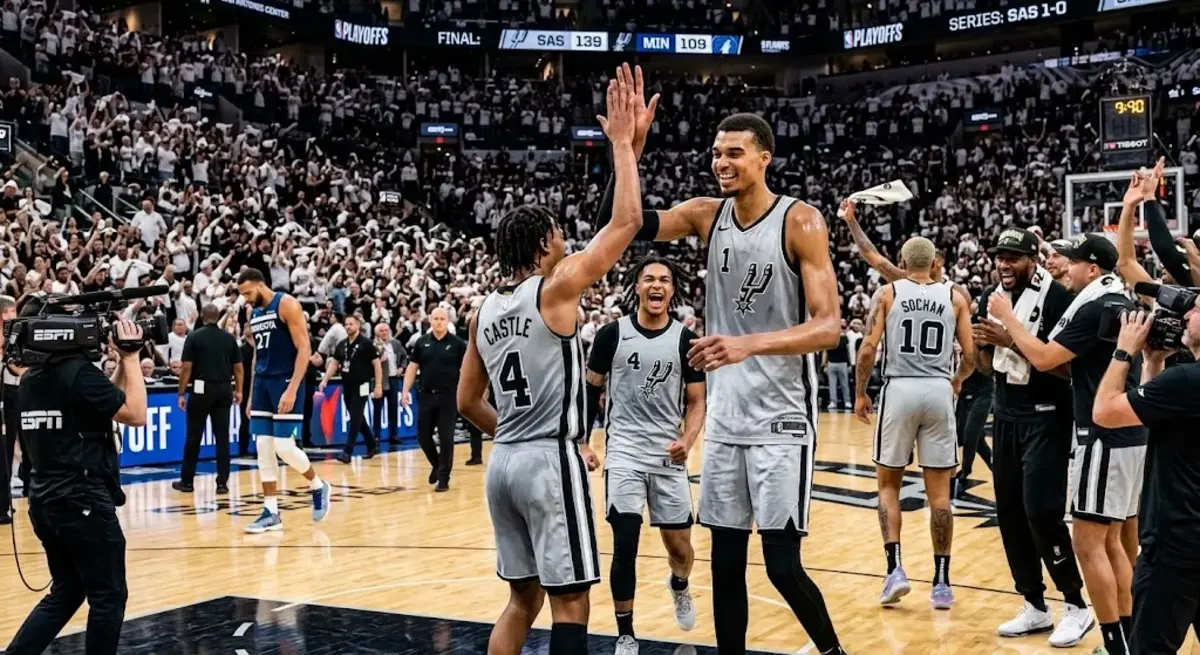
The San Antonio Spurs delivered a shooting performance for the ages, dismantling the Minnesota Timberwolves 139-109 to close out their Western Conference Semifinal series in six games. The san antonio spurs vs timberwolves timeline reached its climax at the Target Center, where San Antonio shot a blistering 55.7% from the field and an astonishing 47.4% from three-point range, ending Minnesota’s season in emphatic fashion.
Match Overview Table
| Information | Match Details |
| Event | NBA Western Conference Semifinals, Game 6 |
| Game | San Antonio Spurs vs Minnesota Timberwolves |
| Date | May 15, 2026 |
| Venue | Target Center, Minneapolis |
| Attendance | 18,978 (sellout) |
| Winner | San Antonio Spurs |
| Final Score | 139-109 |
| Broadcast | ESPN / KENS 5 (local) |
Core Match Statistics Overview
The statistical chasm between these two teams in Game 6 tells the complete story of a series that San Antonio controlled after a rocky start.
| Metric | San Antonio Spurs | Minnesota Timberwolves |
| Field Goal % | 55.7% | 44.0% |
| 3PT % | 47.4% (18-38) | 32.5% (13-40) |
| Free Throws % | 85.2% | 76.9% |
| Rebounds | 60 | 45 |
| Assists | 34 | 24 |
| Turnovers | 16 | 14 |
| Steals | 9 | 7 |
| Blocks | 5 | 4 |
Three-Point Shooting
The perimeter disparity decided this elimination game. San Antonio’s 18 made threes on 38 attempts represented their most efficient long-range performance of the entire series. Minnesota, by contrast, needed 40 attempts to make 13, a 32.5% clip that simply couldn’t keep pace.
- The Spurs’ 47.4% three-point shooting was their second-best mark of the playoffs, trailing only their 50% performance in Game 2.
- Minnesota’s inability to close out on shooters allowed San Antonio to generate clean looks from beyond the arc all evening.
Ball Movement
San Antonio’s 34 assists on 49 made field goals (69.4% assist rate) showcased a level of offensive cohesion Minnesota couldn’t match.
- The Spurs generated 34 assists against only 16 turnovers, a 2.1 assist-to-turnover ratio that reflects disciplined decision-making under playoff pressure.
- Minnesota’s 24 assists came with 14 turnovers, a respectable mark but insufficient when the opposition is shooting at San Antonio’s efficiency.
Rebounding Dominance
The Spurs’ 60-45 rebounding advantage, including 12 offensive boards, gave them extra possessions that Minnesota couldn’t afford to surrender.
- San Antonio’s 48 defensive rebounds limited Minnesota’s second-chance opportunities in a game where every possession mattered.
- The Timberwolves’ inability to secure defensive rebounds allowed the Spurs to extend possessions and drain clock in the second half.
Period-by-Period Analysis
First Quarter: Spurs Establish Control
| Team | Q1 Score |
| San Antonio | 34 |
| Minnesota | 28 |
San Antonio came out aggressive, attacking the paint early before finding their rhythm from deep.- At first, Minnesota managed to keep up with Anthony Edwards’ individual scoring, but defensive lapses started to accumulate.
- The Spurs’ six-point lead after 12 minutes set the tone for a game they would never trail.
Second Quarter: The Run That Broke Minnesota
| Team | Q2 Score |
| San Antonio | 36 |
| Minnesota | 23 |
This was the decisive period. San Antonio outscored Minnesota 36-23, turning a competitive game into a blowout.- The Spurs’ ball movement carved up Minnesota’s defense repeatedly, generating open threes and easy baskets at the rim.
- Minnesota’s offense stagnated into isolation plays, a familiar problem that the Spurs exploited with disciplined help defense.
Third Quarter: Maintaining the Kill Shot
| Team | Q3 Score |
| San Antonio | 35 |
| Minnesota | 30 |
Minnesota showed brief life early in the third, cutting the deficit to 13 on two occasions.- San Antonio responded with the same formula: patient half-court execution and timely three-point shooting.
- The Spurs’ 35-point quarter ensured Minnesota’s momentum never became threatening.
Fourth Quarter: Closing the Series
| Team | Q4 Score |
| San Antonio | 34 |
| Minnesota | 28 |
With the outcome decided, San Antonio maintained their efficiency rather than simply running clock.- The Spurs’ bench contributions in the final period underscored the depth advantage they held throughout this series.
- Minnesota emptied their bench with four minutes remaining, acknowledging the series was over.
Detailed Team Player Statistics
San Antonio Spurs Player Statistics
Stephon Castle delivered a breakout playoff performance: 24 points, 7 rebounds, 6 assists. The rookie’s poise in an elimination game on the road demonstrated why San Antonio’s future is remarkably bright. His ability to score at all three levels kept Minnesota’s defense guessing all night.
De’Aaron Fox controlled the tempo masterfully: 22 points, 8 assists, 4 rebounds. Throughout the second and third quarters, Fox’s decision-making in pick-and-roll scenarios created open looks for teammates, and his quickness in transition frequently put Minnesota into scramble mode.
Victor Wembanyama anchored both ends: 21 points, 12 rebounds, 4 blocks. While his scoring numbers weren’t gaudy by his standards, Wembanyama’s defensive presence altered countless Minnesota drives, and his 12 rebounds helped San Antonio dominate the glass.
Devin Vassell provided efficient supplementary scoring: 18 points, 4 rebounds, 3 assists. Vassell’s off-ball movement created consistent catch-and-shoot opportunities, and he converted at a high rate when Minnesota’s defense collapsed on Wembanyama.
Minnesota Timberwolves Player Statistics
Anthony Edwards fought valiantly in defeat: 25 points, 6 rebounds, 5 assists. The Timberwolves’ franchise player shot just 9-of-22 from the field, struggling against San Antonio’s rotating double-teams that forced the ball out of his hands.
Naz Reid provided the most consistent offensive support: 20 points, 7 rebounds, 2 blocks off the bench. Reid’s versatility as a stretch-five gave San Antonio problems in the first half before the Spurs adjusted their closeout patterns.
Julius Randle endured a difficult evening: 14 points on 5-of-14 shooting, 6 rebounds. Randle’s inability to score efficiently against San Antonio’s length forced Minnesota into uncomfortable offensive possessions throughout the second half.
Jaden McDaniels contributed defensively but struggled offensively: 12 points, 5 rebounds, 2 steals. Tasked with guarding multiple positions, McDaniels’ energy was evident but his shot wasn’t falling consistently.
Statistical Leaders Summary Table
| Category | San Antonio Spurs | Minnesota Timberwolves |
| Leading Scorer | Stephon Castle (24) | Anthony Edwards (25) |
| Second Leading Scorer | De’Aaron Fox (22) | Naz Reid (20) |
| Top Rebounder | Victor Wembanyama (12) | Rudy Gobert (9) |
| Most Assists | De’Aaron Fox (8) | Anthony Edwards (5) |
Analytical Breakdowns
Why the Spurs Won
Historic Shooting Efficiency
San Antonio’s 55.7% field goal percentage and 47.4% three-point percentage represented a rare combination of volume and accuracy. The Spurs didn’t simply get hot; they generated high-quality looks through deliberate ball movement and patient execution.
| Shooting Metric | Game 6 Performance |
| Effective FG% | 68.9% |
| True Shooting % | 69.6% |
| Points in Paint | 52 |
Balanced Scoring Attack
Six Spurs scored in double figures, a hallmark of San Antonio’s offensive system throughout the series. When Minnesota focused defensive attention on Wembanyama, Castle, Fox, and Vassell punished them repeatedly.
Defensive Adjustments
After allowing 141 points in a March loss to Minnesota, San Antonio’s coaching staff implemented changes that paid dividends in the playoffs. The Spurs held Minnesota to 109 points in the clincher, their second-lowest output of the series.
Why the Timberwolves Lost
Perimeter Defense Collapse
Minnesota’s inability to contain San Antonio’s three-point shooting doomed their comeback hopes. The Spurs’ 18 made threes came on clean looks created by dribble penetration and skip passes that the Timberwolves’ rotations couldn’t reach in time.
Offensive Stagnation
When Anthony Edwards faced double-teams, Minnesota’s offense lacked a secondary creator capable of exploiting the 4-on-3 advantage. Julius Randle’s struggles as a playmaker and Mike Conley’s reduced role left the Timberwolves without a reliable pressure release valve.
| Minnesota Offensive Metric | Game 6 |
| Assists | 24 |
| Turnovers | 14 |
| Points off Turnovers | 12 |
Rebounding Deficit
Surrendering 60 rebounds, including 12 on the offensive glass, gave San Antonio extra possessions that proved decisive. Rudy Gobert’s 9 rebounds were a season-low for the series, reflecting San Antonio’s emphasis on boxing out the French center.
Historical Context & Advanced Insights
Season Series Breakdown
| Date | Result | Location |
| Nov 30, 2025 | Timberwolves 125, Spurs 112 | Minnesota |
| Jan 11, 2026 | Timberwolves 104, Spurs 103 | Minnesota |
| Jan 17, 2026 | Spurs 126, Timberwolves 123 | San Antonio |
| May 4, 2026 | Timberwolves 104, Spurs 102 | San Antonio (Game 1) |
| May 6, 2026 | Spurs 133, Timberwolves 95 | San Antonio (Game 2) |
| May 8, 2026 | Spurs 115, Timberwolves 108 | Minnesota (Game 3) |
| May 10, 2026 | Timberwolves 114, Spurs 109 | Minnesota (Game 4) |
| May 12, 2026 | Spurs 126, Timberwolves 97 | San Antonio (Game 5) |
| May 15, 2026 | Spurs 139, Timberwolves 109 | Minnesota (Game 6) |
The san antonio spurs vs timberwolves timeline reveals a fascinating arc: Minnesota won both regular-season meetings in Minneapolis, but San Antonio’s adjustments after Game 1 transformed the series. The Spurs won four of the final five games, with their only loss coming in a Game 4 where Wembanyama was controversially ejected.
Advanced Statistical Insights
In Game 6, the Spurs had exceptional offensive execution with an assist-to-field-goal ratio of 0.694 (34 assists on 49 field goals). For context, the NBA average during the 2025-26 regular season hovered around 0.60. This metric reflects San Antonio’s commitment to generating open shots through passing rather than relying on individual creation.
Minnesota’s defensive rating in the series ballooned to 118.3, well above their regular-season mark. The Timberwolves simply couldn’t solve San Antonio’s pick-and-roll actions, particularly when Wembanyama operated as the roll man with Fox or Castle initiating.
Game Implications & Key Lessons
What This Means for San Antonio
- The Spurs advance to the Western Conference Finals for the first time since 2017, validating their rebuild and establishing them as legitimate contenders.
- Stephon Castle’s emergence as a playoff performer gives San Antonio a third star alongside Wembanyama and Fox.
- The team’s defensive versatility—they held Minnesota to under 100 points twice in the series—suggests they can match up with any remaining opponent.
What This Means for Minnesota
- Anthony Edwards needs a reliable secondary creator. The Timberwolves’ offense became too predictable when defenses loaded up on Edwards.
- Julius Randle’s fit alongside Edwards and Gobert remains questionable. His inability to space the floor or facilitate in the half-court limits Minnesota’s offensive ceiling.
- The Timberwolves must address their three-point defense in the offseason. San Antonio’s 47.4% performance in Game 6 wasn’t an aberration; it was the culmination of a series-long trend.
Key Lessons
- When produced by ball movement, elite three-point shooting may negate even the best individual defenders.
- Playoff series are won through adjustments. San Antonio’s coaching staff outmaneuvered Minnesota after Game 1.
- Depth matters in elimination games. The Spurs’ bench outscored Minnesota’s reserves in four of six games.
- Rebounding remains a non-negotiable playoff fundamental. The Spurs’ 60-45 advantage in Game 6 directly translated to extra possessions.
- Containing a superstar requires collective discipline. San Antonio’s rotating double-teams on Edwards forced other Timberwolves to beat them, and they couldn’t.
- Young teams can win in the playoffs if they defend and execute. Poise is not just a quality of veterans, as seen by Castle’s rookie play in Game 6.
Conclusion
The san antonio spurs vs timberwolves timeline concluded with a masterclass in playoff execution. San Antonio’s 139-109 victory wasn’t simply a hot shooting night; it was the product of systematic offensive precision, defensive discipline, and the kind of depth that separates contenders from pretenders.
Minnesota’s season ends with legitimate questions about their roster construction around Anthony Edwards, while San Antonio marches forward with a young core that appears ready to compete for championships for years to come. The Spurs’ 55.7% field goal shooting and 47.4% three-point accuracy in an elimination game on the road represents the standard they’ll need to maintain as the competition intensifies.