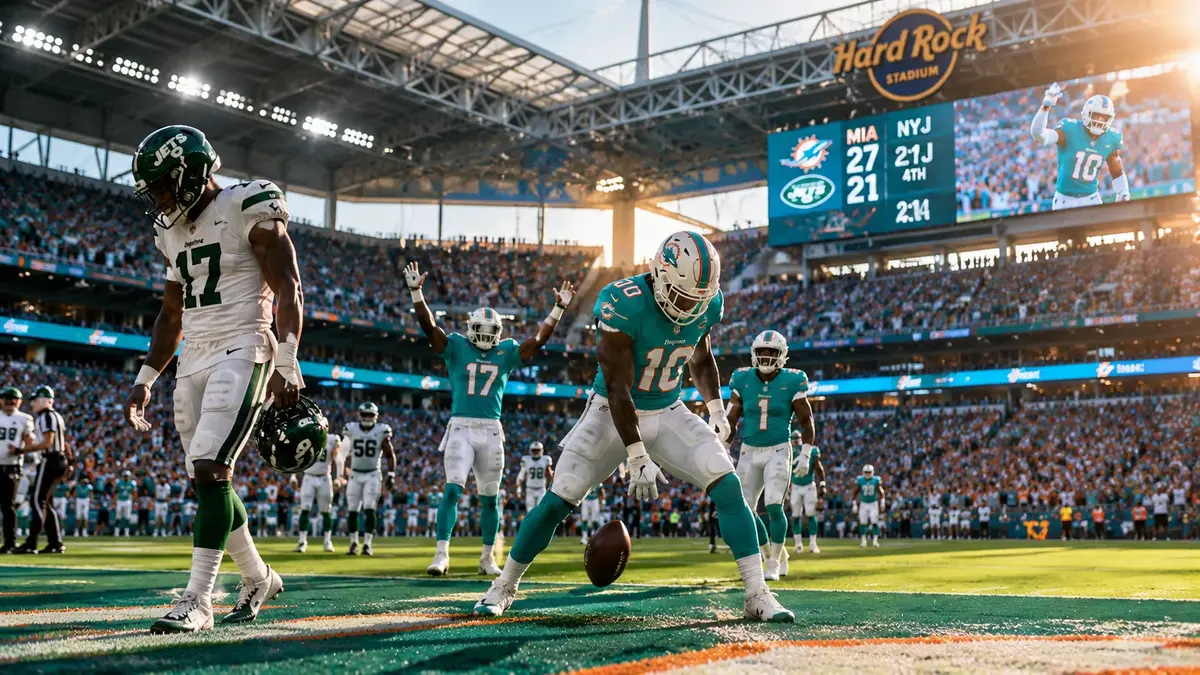
The Miami Dolphins vs New York Jets delivered a textbook case of what happens when a team controls the trenches and protects the football. Miami leaned on a punishing red-zone efficiency advantage and a flawless turnover margin to secure a 27-21 victory, moving to 1-3 on the young season while dropping New York to 0-4 .
The Jets actually out-gained Miami by a significant margin, piling up 404 total yards to the Dolphins’ 300. However, football games are decided by scoring opportunities and mistakes. Miami played a clean brand of football with no giveaways, while New York fumbled the ball three times. The Dolphins converted all three of their red-zone trips into touchdowns, while the Jets failed to score a single touchdown on their two red-zone possessions . That disparity—not the bulk yardage—was the deciding factor in this divisional matchup.
Match Overview
| Information | Match Details |
| Event | NFL Regular Season |
| Game | Miami Dolphins vs New York Jets |
| Date | September 29, 2025 |
| Venue | Hard Rock Stadium |
| Attendance | 65,848 |
| Winner | Miami Dolphins |
| Final Score | 27-21 |
| Broadcast | FOX |
Core Match Statistics Overview
The box score reveals a game where the Jets moved the ball more effectively between the twenties but collapsed in the moments that mattered most.
| Metric | Miami Dolphins | New York Jets |
| Total Yards | 300 | 404 |
| Yards Per Play | 5.4 | 7.1 |
| Passing Yards | 177 | 207 |
| Rushing Yards | 123 | 197 |
| Yards Per Rush | 4.0 | 7.0 |
| Red Zone Touchdowns | 3 | 0 |
| Turnovers | 0 | 3 |
| Sacks | 2 | 0 |
Red Zone Execution
- Miami scored a touchdown on all three of its red-zone appearances, demonstrating a ruthless finishing instinct that the Jets completely lacked.
- New York entered the red zone twice and came away with zero points from touchdowns, a failure that directly cost them the game .
Ball Security
- The Dolphins protected the football with zero interceptions and zero lost fumbles, giving their defense a chance to stay fresh.
- New York put the ball on the ground three times and lost all three, killing drives and handing Miami short fields .
Defensive Splash Plays
- Miami recorded two sacks and five tackles for loss, consistently disrupting the Jets’ rhythm on critical downs.
- The Jets failed to record a single sack, allowing Miami’s quarterback to operate without pressure on key third downs .
Period-by-Period Analysis
The game followed a pattern of Miami building early leads and New York clawing back, only to run out of time.
| Period | Dolphins | Jets |
| Q1 | 7 | 0 |
| Q2 | 10 | 7 |
| Q3 | 7 | 7 |
| Q4 | 3 | 7 |
First Half Momentum: Miami jumped out to a 7-0 first-quarter lead and extended it to 17-7 by halftime, exploiting New York’s red-zone failures. The Jets moved the ball well between the twenties but stalled when the field compressed .
Third Quarter Exchange: Both teams found the end zone once in the third, but Miami’s touchdown came on a methodical drive while New York’s required explosive plays that were unsustainable.
Fourth Quarter Survival: The Jets scored late to make it a one-score game, but Miami’s zero-turnover approach and a late field goal sealed the outcome. New York’s three lost fumbles proved insurmountable.
Miami Dolphins Player Statistics
Quarterback Play
The Miami signal-caller managed the game efficiently, completing 17 of 25 passes for 177 yards and two touchdowns with no interceptions. The defense and rushing game took care of everything, so he did not have to exert any pressure.
Running Back Production
Miami’s backfield committee combined for 123 yards on 31 carries, averaging a modest 4.0 yards per attempt. The value came in short-yardage and goal-line situations, where the Dolphins converted consistently.
Defensive Difference-Makers
The Miami defense bent but didn’t break. Two sacks and three forced fumbles defined the afternoon, with the pass rush generating timely pressure on third downs and the secondary capitalizing on New York’s ball security issues .
New York Jets Player Statistics
Quarterback Efficiency
The Jets’ quarterback completed 20 of 27 passes for 207 yards and a touchdown, posting a solid 7.7 yards per attempt. However, ball security was the story—the fumbles, not the arm, undid New York’s offensive effort .
Rushing Attack
New York ran the ball effectively, gaining 197 yards on 28 attempts for a robust 7.0 yards per carry. The ground game was the engine of the offense, but it couldn’t compensate for the turnovers in scoring territory.
Defensive Struggles
The Jets’ defense failed to generate pressure, recording zero sacks and only two tackles for loss. They allowed Miami to convert red-zone opportunities at a perfect rate, a failure that negated their otherwise competitive yardage totals .
Statistical Leaders Summary
| Category | Miami Dolphins | New York Jets |
| Leading Passer | 177 Yds, 2 TD, 0 INT | 207 Yds, 1 TD |
| Leading Rusher | 123 Team Rush Yds | 197 Team Rush Yds |
| Top Defensive Metric | 2 Sacks, 3 FF | 0 Sacks |
| Turnover Margin | 0 Giveaways | 3 Lost Fumbles |
Why Miami Won
Red-Zone Perfection
| Team | Red Zone Trips | Touchdowns | Success Rate |
| Miami | 3 | 3 | 100% |
| New York | 2 | 0 | 0% |
Miami’s ability to finish drives separated the two teams. The Dolphins didn’t accumulate gaudy yardage, but they scored when the field shrank .
Zero Turnovers
| Team | Fumbles Lost | Interceptions | Total Giveaways |
| Miami | 0 | 0 | 0 |
| New York | 3 | 0 | 3 |
In a game decided by seven points, three lost fumbles represent a massive swing. Miami’s offense never gifted possession back to New York, forcing the Jets to earn every yard.
Why New York Lost
Red-Zone Incompetence
The Jets moved the ball at will between the twenties but froze when the end zone came into view. Two red-zone trips yielded zero touchdowns, a failure that erased the advantage created by their 404-yard output .
Ball Security Collapse
Three lost fumbles turned a competitive offensive performance into a losing effort. The Jets out-gained Miami by over 100 yards but gave the ball away three times, negating their statistical dominance.
Historical Context & Advanced Insights
Season Series Context
This Week 4 matchup was the first of two meetings between these AFC East rivals in 2025. The Dolphins would go on to sweep the series with a 34-10 victory in Week 14 at MetLife Stadium, a game defined by a 239-yard rushing performance and six defensive sacks .
Efficiency vs. Volume
The Miami Dolphins vs New York Jets box score illustrates a fundamental football truth: yards between the twenties matter far less than execution in scoring territory and ball security. New York averaged 7.1 yards per play compared to Miami’s 5.4, yet lost the game . The Jets’ three lost fumbles and zero red-zone touchdowns created a points gap that their yardage advantage could not close. Miami’s perfect red-zone conversion rate and clean sheet in the turnover column were the true determinants of the outcome.
Game Implications & Key Lessons
What This Means for Miami:
- The Dolphins proved they can win without dominant offensive volume, a trait that builds confidence in close divisional games.
- Red-zone execution and ball security became identifiable strengths to build upon.
- The victory provided a blueprint for complementary football that would later fuel a four-game winning streak .
What This Means for New York:
- The Jets’ inability to finish drives in scoring territory remains a critical flaw despite effective yardage production.
- Ball security must become a point of emphasis; three lost fumbles erased an otherwise productive offensive afternoon.
- The loss dropped New York to 0-4, setting the stage for a season that would ultimately end without a playoff appearance for the fifteenth consecutive year .
Key Lessons:
- Yardage totals are meaningless without red-zone execution.
- Turnover margin remains the most reliable predictor of close-game outcomes.
- A zero-sack defensive performance eliminates any margin for error on offense.
- Three red-zone touchdowns will beat two red-zone stops in almost any NFL game.
- Protecting the football is a skill that separates disciplined teams from pretenders.
Conclusion
The Miami Dolphins vs New York Jets matchup was not a beauty contest by traditional statistical standards. New York moved the ball more effectively, averaged more yards per play, and controlled possession. But the Jets lost because they could not finish drives and could not hold onto the football. Miami won because it maximized its red-zone opportunities and protected the ball with zero giveaways. In a league where explosive yardage often dominates highlight reels, this game served as a reminder that execution in the margins—the red zone and the turnover column—still decides outcomes. The Dolphins left Hard Rock Stadium with a win they earned through discipline rather than dominance.