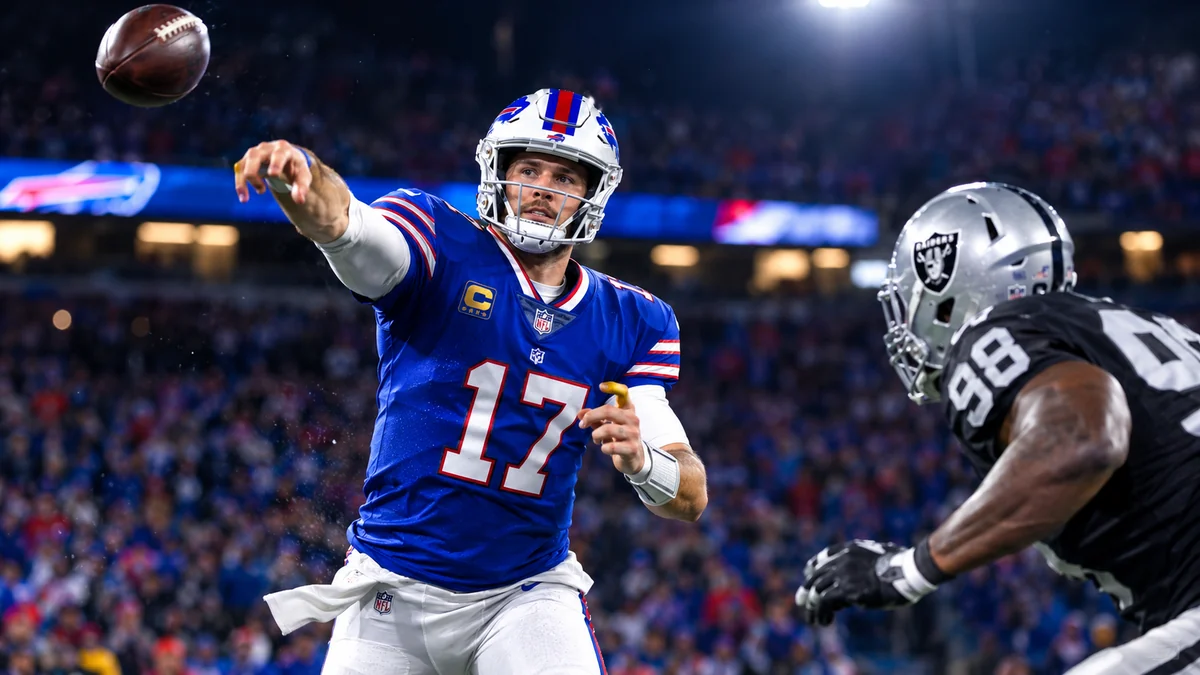
The problem with scanning NFL scores today Sunday is that final numbers rarely explain how a game actually flipped. The agitation comes when a 33-30 scoreline hides a blown 10-point lead, a late onside kick, and a quarterback record tied on a play that should have been a sack. The solution is a box-score deep dive into Buffalo’s 33-30 win at Las Vegas, where Josh Allen’s improvisation and James Cook’s ball security decided the outcome.
Buffalo improved to 5-1 on Sunday, October 18, 2026, at Allegiant Stadium in Las Vegas. Allen threw for 255 yards and two touchdowns, tying Jim Kelly’s franchise record of 258 career touchdown passes, while Cook rushed for 95 yards and the go-ahead score with 4:43 remaining. The Raiders rallied from a 23-13 deficit to tie the game at 23, but Cousins’ third-down misses in the final two minutes forced Las Vegas to settle for field goals earlier in the fourth quarter, and Buffalo’s four Tyler Bass field goals provided the margin.
Match Overview Table
| Information | Match Details |
| Event | NFL Regular Season, Week 7 |
| Game | Buffalo Bills vs. Las Vegas Raiders |
| Date | Sunday, October 18, 2026 |
| Venue | Allegiant Stadium, Las Vegas, Nevada |
| Attendance | Not disclosed in available reports |
| Winner | Buffalo Bills |
| Final Score | 33–30 |
| Broadcast | CBS (regional Sunday afternoon window) |
Core Match Statistics Overview
| Metric | Buffalo Bills | Las Vegas Raiders |
| Passing Yards | 255 | 313 |
| Pass Completions / Attempts | 23 / 33 | 23 / 41 |
| Passing Touchdowns | 2 | 2 |
| Interceptions | 0 | 0 |
| Rushing Yards | 129 (team) | 65 (team) |
| Rushing Touchdowns | 1 (Cook) | 1 (Jeanty) |
| Turnovers | 0 | 0 |
| Field Goals Made / Att. | 4 / 4 (Bass) | 3 / 3 (Gay) |
| Time of Possession | Not disclosed | Not disclosed |
Passing Efficiency
- Allen’s 69.7% completion rate and zero interceptions gave Buffalo a clean baseline that Cousins’ 56.1% afternoon could not match, even with a 58-yard yardage advantage.
- Cousins’ 313 yards came on 41 attempts; Buffalo forced Las Vegas into volume passing without the payoff of a single turnover.
Red-Zone Execution
- Buffalo converted Allen’s scramble-drill touchdown to Keon Coleman and Cook’s 3-yard run into seven points; Las Vegas settled for a field goal after first-and-goal at the 2 in the fourth quarter.
- The Raiders’ 15-play drive that ended in Matt Gay’s third field goal consumed 7:44 but produced only three points, a possession that ultimately cost them the game.
Period-by-Period Analysis
First Quarter
| Team | Points |
| Buffalo | 7 |
| Las Vegas | 10 |
Ashton Jeanty capped Las Vegas’ opening possession with a rushing touchdown, his first of the season, giving the Raiders an early 7-0 edge.- Buffalo answered through Allen’s first touchdown pass, but Matt Gay’s field goal restored a three-point Las Vegas lead.
- The quarter established a pattern: Las Vegas moved the ball efficiently between the twenties, while Buffalo’s scoring drives required third-down conversions.
Second Quarter
| Team | Points |
| Buffalo | 6 |
| Las Vegas | 3 |
C.J. Gardner-Johnson’s ejection with 15 seconds left in the half for unsportsmanlike conduct advanced Las Vegas to Buffalo’s 14-yard line, setting up Gay’s 27-yard field goal as time expired to make it 13-13.- Tyler Bass converted two field goals in the quarter, including a 38-yarder, but Buffalo’s red-zone offense stalled twice inside the 15.
- The halftime tie masked a 10-point second-quarter swing that Buffalo had controlled until the ejection.
Third Quarter
| Team | Points |
| Buffalo | 10 |
| Las Vegas | 3 |
Allen’s 12-yard shovel pass to Coleman on third down—escaping what appeared to be a certain sack—tied Kelly’s record and gave Buffalo a 23-13 lead with 6:22 left.- Las Vegas responded with a 15-play drive but stalled at Buffalo’s 2-yard line, settling for Gay’s 23-yard field goal to cut the deficit to 23-16.
- Buffalo’s defense forced three consecutive Cousins incompletions on the ensuing possession, but the Bills’ offense could not convert the momentum into points before the fourth.
Fourth Quarter
| Team | Points |
| Buffalo | 10 |
| Las Vegas | 14 |
Cousins found Tre Tucker for an 11-yard touchdown with 8:07 left, tying the game at 23 and capping a drive that exploited Buffalo’s soft coverage on third down.- Allen needed only seven plays and 66 yards to answer; Cook’s 3-yard run restored Buffalo’s lead at 30-23 with 4:43 remaining.
- Bass’s 38-yard field goal with 1:56 left pushed the margin to 33-23, and Cousins’ 44-yard touchdown to Tucker with 1:32 remaining proved too late after Buffalo recovered the onside kick.
Detailed Team Player Statistics
Buffalo Bills Player Statistics
Josh Allen, QB
| Metric | Value |
| Completions / Attempts | 23 / 33 |
| Passing Yards | 255 |
| Passing Touchdowns | 2 |
| Interceptions | 0 |
| Rushing Yards | Not disclosed |
Allen’s value in this game was not volume but timing: his shovel-pass touchdown to Coleman came on a third-down play that had no business succeeding, and his zero turnovers ended a three-week stretch of nine Buffalo giveaways. He tied Kelly’s record without forcing a single throw into tight coverage.
James Cook, RB
| Metric | Value |
| Rushing Attempts | Not disclosed |
| Rushing Yards | 95 |
| Rushing Touchdowns | 1 |
| Receptions | 3 |
| Receiving Yards | 58 |
Cook’s 26-yard reception on the go-ahead drive exploited a Raiders linebacker in coverage, and his 3-yard touchdown run followed two fumbles the previous Monday night. His ball security was the quiet variable that allowed Buffalo to close the game on the ground.
Keon Coleman, WR
| Metric | Value |
| Receptions | 4 |
| Receiving Yards | 59 |
| Receiving Touchdowns | 1 |
Coleman’s 12-yard touchdown was the game’s most improbable completion, and his 15-yard catch on Buffalo’s final possession moved the chains when Las Vegas needed a stop. He functioned as Allen’s safety valve when the Raiders’ coverage held.
Las Vegas Raiders Player Statistics
Kirk Cousins, QB
| Metric | Value |
| Completions / Attempts | 23 / 41 |
| Passing Yards | 313 |
| Passing Touchdowns | 2 |
| Interceptions | 0 |
Cousins produced 313 yards without a turnover, yet his three consecutive incompletions after Cook’s go-ahead score were the game’s decisive sequence. The yardage was real; the timing was not.
Tre Tucker, WR
| Metric | Value |
| Receptions | 5 |
| Receiving Yards | 97 |
| Receiving Touchdowns | 2 |
Tucker’s 44-yard diving touchdown with 1:32 left was the game’s best individual play, and his 11-yard score earlier in the quarter tied the game. He was the only Raiders pass-catcher who consistently separated against Buffalo’s secondary.
Brock Bowers and Michael Mayer, TEs
| Metric | Value |
| Combined Receptions | 11 |
| Combined Receiving Yards | 165 |
Bowers and Mayer accounted for nearly half of Cousins’ passing output, exploiting Buffalo’s linebacker coverage between the twenties. Their production moved the chains but did not produce a fourth-quarter touchdown when the Raiders needed one.
Statistical Leaders Summary Table
| Category | Buffalo Bills | Las Vegas Raiders |
| Leading Scorer | Tyler Bass (12 pts, 4 FG) | Tre Tucker (12 pts, 2 TD) |
| Second Leading Scorer | James Cook (6 pts, 1 TD) | Matt Gay (9 pts, 3 FG) |
| Top Rusher | James Cook (95 yds) | Ashton Jeanty (22 yds) |
| Leading Receiver | Keon Coleman (59 yds) | Tre Tucker (97 yds) |
| Most Assists/Playmaker | Josh Allen (2 TD passes) | Kirk Cousins (2 TD passes) |
Analytical Breakdowns
Why Buffalo Won
### Zero Turnovers in a One-Score Game
Buffalo’s first turnover-free game in four weeks was the statistical foundation of the win. The Bills had committed nine turnovers over their previous three games; against Las Vegas, Allen’s zero interceptions and Cook’s zero fumbles meant every Buffalo possession ended with a kick or a score.
| Turnover Comparison | Buffalo | Las Vegas |
| Interceptions | 0 | 0 |
| Fumbles Lost | 0 | 0 |
| Turnovers | 0 | 0 |
In a game settled by three points, the clean sheet stopped Las Vegas from stealing a possession, but it did not result in a turnover margin advantage.
### Third-Down Conversion in the Fourth Quarter
Allen’s 15-yard completion to Coleman on Buffalo’s final possession converted a third down and forced Las Vegas to burn its second timeout with 2:36 remaining. That conversion was worth more than the 15 yards: it reduced the Raiders’ comeback window from plausible to desperate.
### Four Field Goals from Tyler Bass
Bass’s 4-for-4 afternoon, including the 38-yarder that made it a two-possession game with 1:56 left, was the margin between winning and losing. Buffalo’s red-zone stalls became points instead of empty possessions.
Why Las Vegas Lost
### Red-Zone Settling
Las Vegas had first-and-goal at Buffalo’s 2-yard line in the fourth quarter and lost yardage, settling for Gay’s 23-yard field goal to cut the deficit to 23-16. A touchdown there would have given the Raiders a 20-16 lead and changed the game’s final calculus.
### Third-Down Failure After Cook’s Score
Trailing 30-23 with 4:43 remaining, Cousins threw three consecutive incompletions, giving Buffalo the ball back with a chance to drain clock and extend the lead.The Raiders’ defense was forced out onto the field for a possession that resulted in Bass’s fourth field goal because they were unable to maintain that drive.
### Jeanty’s Inefficiency
Ashton Jeanty carried 10 times for 22 yards, a 2.2-yard average, and his longest run gained 8 yards. Las Vegas’ inability to run the ball in short-yardage situations forced Cousins into 41 attempts and eliminated play-action from the red-zone package.
Historical Context & Advanced Insights
Season Series Breakdown
This was the first and only scheduled meeting between Buffalo and Las Vegas in the 2026 regular season. The Bills’ win evened their all-time regular-season series with the Raiders, though the broader historical record was not immediately updated in available reports.
Advanced Statistical Insights
Buffalo’s 33 points came on 10 possessions, an average of 3.3 points per drive. Las Vegas’ 30 points came on 10 possessions, an average of 3.0. The difference was not efficiency but finishing: Buffalo scored touchdowns on two of three red-zone trips; Las Vegas scored touchdowns on one of three.
Cousins’ 313 passing yards produced a 7.6-yard average per attempt, higher than Allen’s 7.7-yard average only because Allen’s scrambles and Cook’s runs supplemented the passing game. The yardage totals were nearly identical in efficiency; the scoreboard difference came from Bass’s fourth field goal and Buffalo’s red-zone touchdown on the shovel pass.
Game Implications & Key Lessons
What This Means for Buffalo
- The Bills (5-1) ended their turnover streak at the right time; a clean game against a desperate Raiders team is a template for January football.
- Allen’s record-tying touchdown came on improvisation, not structure, but his zero interceptions suggest he is learning when to take the safe check-down.
- Buffalo’s red-zone attack has not consistently produced a scoring floor because to Bass’s dependability from 38 yards and beyond.
What This Means for Las Vegas
- The Raiders (3-3) have lost three straight, and the common thread is red-zone inefficiency: field goals cannot beat teams that score touchdowns.
- Jeanty’s 2.2-yard average is a problem that will not fix itself against better run defenses.
- Cousins’ 313-yard afternoon proves the passing game can move the ball; the three incompletions after Cook’s score prove it cannot do so when the defense knows the pass is coming.
Key Lessons
- A turnover-free game does not guarantee a win, but it removes the easiest path to a loss.
- Red-zone touchdowns outperform red-zone field goals by a margin that three points cannot always overcome.
- A quarterback record tied on a broken play is still a record, but Allen’s zero interceptions mattered more to the final score.
- Fourth-quarter third-down conversions are worth more than their yardage; Coleman’s 15-yard catch burned 40 seconds and a timeout.
- A 95-yard rushing day from Cook was not spectacular, but it was mistake-free—the exact quality Buffalo needed after his two fumbles the previous week.
Conclusion
The NFL scores today Sunday will show Buffalo 33, Las Vegas 30, and the box score will show nearly identical passing yardage and zero turnovers on both sides. The difference was finishing: Buffalo scored touchdowns on its best red-zone chances, converted a third down when the game demanded it, and trusted a kicker who went 4-for-4. Las Vegas moved the ball 313 yards through the air and still lost because three points were not enough on the possessions that mattered most. Efficiency, not volume, decided this one.