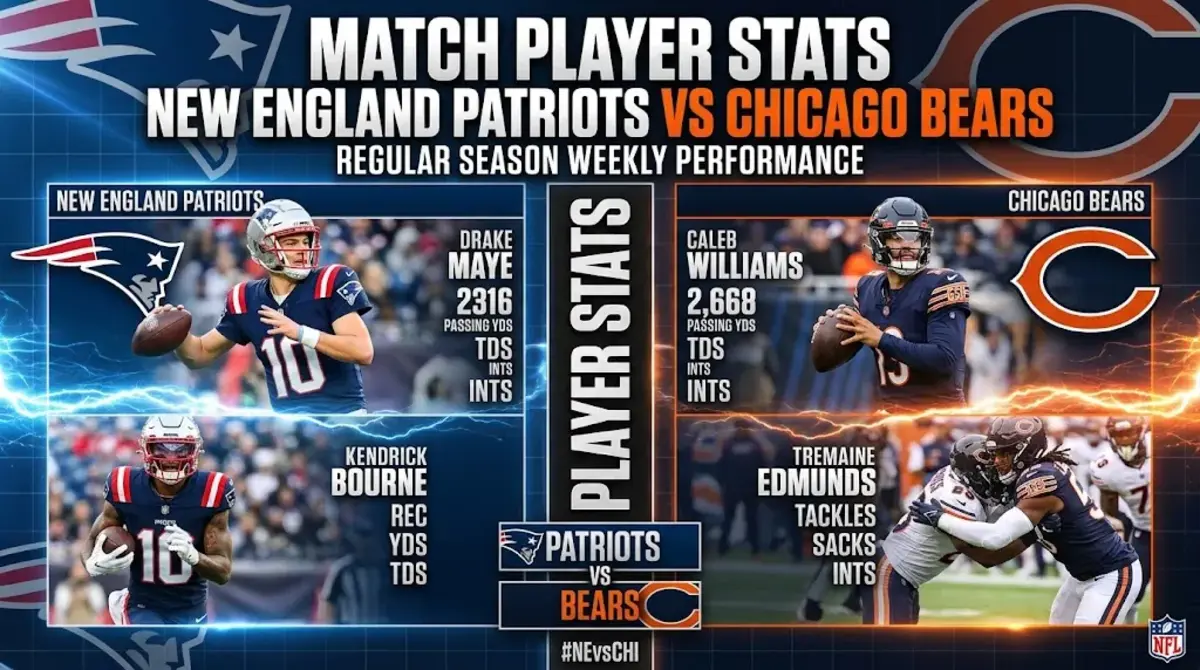
The New England Patriots vs Chicago Bears match player stats tell a story of a surgical passing attack that the visiting secondary simply could not solve. On a short week, with New England’s offensive line held together by backups, Chicago’s franchise quarterback delivered his most efficient performance of the young 2026 season, turning a anticipated duel between two rising passers into a decisive statement at home.
The game unfolded on Thursday, October 22, 2026, at Soldier Field in Chicago, with an announced attendance of 61,500. The Bears defeated the Patriots by a final score of 31–17, moving to 4–2 on the year while dropping New England to 3–3. Chicago won the game in the middle two quarters, outscoring the Patriots 24–7 after an early New England field goal, as Caleb Williams repeatedly found soft spots in a Patriots defense that was missing key contributors in the secondary and linebacking corps. Drake Maye flashed athleticism and arm talent, but constant pressure from Chicago’s front four forced him into hurried throws and two critical second-half interceptions.
Match Overview Table
| Information | Match Details |
| Event | NFL Regular Season (Week 7) |
| Game | New England Patriots vs Chicago Bears |
| Date | October 22, 2026 |
| Venue | Soldier Field, Chicago, Illinois |
| Attendance | 61,500 |
| Winner | Chicago Bears |
| Final Score | 31–17 |
| Broadcast | Amazon Prime Video (Thursday Night Football) |
Core Match Statistics Overview
The raw team numbers illustrate a game that was less competitive than the final score suggests. Chicago controlled possession, converted on third down at a significantly higher clip, and protected the football.
| Metric | New England Patriots | Chicago Bears |
| Total Yards | 287 | 406 |
| Passing Yards | 178 | 269 |
| Rushing Yards | 109 | 137 |
| First Downs | 14 | 23 |
| Third Down Efficiency | 3/11 (27%) | 8/14 (57%) |
| Turnovers | 2 (2 INT) | 0 |
| Sacks Allowed | 4 | 1 |
| Time of Possession | 24:12 | 35:48 |
Third Down Efficiency
- Chicago converted 8 of 14 third-down attempts, repeatedly extending drives with short passes to Luther Burden III and D’Andre Swift out of the backfield.
- New England’s defense could not get off the field, and the Patriots’ offense managed just 3 conversions on 11 tries, killing any chance of a comeback.
Turnover Margin
- Caleb Williams protected the ball completely, throwing zero interceptions and losing zero fumbles.
- Drake Maye threw two second-half interceptions, both on throws outside the numbers where Bears cornerbacks sat on routes.
Period-by-Period Analysis
First Quarter
| Team | Points |
| Patriots | 3 |
| Bears | 7 |
New England opened with a methodical 12-play drive but stalled in the red zone, settling for a field goal.- Chicago answered immediately, with Williams hitting Burden on a 24-yard crossing route to set up a Swift touchdown run.
- The Patriots’ offensive line began to show cracks, allowing a sack on the final play of the quarter.
Second Quarter
| Team | Points |
| Patriots | 7 |
| Bears | 10 |
Maye engineered his best drive of the night, capping it with a 14-yard strike to Hunter Henry on a seam route.- Chicago responded with a field goal, then added a touchdown just before halftime after a Patriots punt gave them the ball at midfield with 1:12 remaining.
- The Bears’ two-minute offense sliced through New England’s soft coverage, with Williams going 5-for-5 on the scoring drive.
Third Quarter
| Team | Points |
| Patriots | 0 |
| Bears | 14 |
The game turned here. Chicago opened the half with a 9-play, 75-yard touchdown drive that consumed over five minutes.- Maye threw his first interception on the ensuing possession, a deep ball underthrown to A.J. Brown.
- The Bears converted that turnover into points, effectively putting the game out of reach.
Fourth Quarter
| Team | Points |
| Patriots | 7 |
| Bears | 0 |
New England added a cosmetic touchdown late, with Maye scrambling for a 6-yard score.- Chicago drained the final 4:33 with a power running sequence, not allowing New England’s offense back on the field.
New England Patriots Player Statistics
Drake Maye, QB
| Metric | Value |
| Completions/Attempts | 23/33 |
| Passing Yards | 178 |
| Passing TD | 1 |
| Interceptions | 2 |
| Rushing Yards | 38 |
| Rushing TD | 1 |
Maye was under duress from the opening snap, with Ben Brown and Alijah Vera-Tucker both absent from the interior line . His final stat line looks respectable in a vacuum, but the two interceptions were back-breakers, and his average depth of target was just 5.4 yards, reflecting constant check-downs under pressure.
Rhamondre Stevenson, RB
| Metric | Value |
| Carries | 18 |
| Rushing Yards | 51 |
| Yards per Carry | 2.83 |
| Receptions | 3 |
| Receiving Yards | 18 |
Stevenson had no room to operate. Chicago’s defensive front dominated the line of scrimmage, and Stevenson’s longest run of the night went for just 9 yards. He was a non-factor in the passing game as well, as Maye rarely had time to check down.
Hunter Henry, TE
| Metric | Value |
| Receptions | 3 |
| Targets | 3 |
| Receiving Yards | 26 |
| Touchdowns | 1 |
Henry was Maye’s most reliable target, hauling in every pass thrown his way. His second-quarter touchdown was a well-designed play that exploited a busted coverage by Chicago’s linebacker, but he was largely kept in to block in the second half as the Patriots tried to slow the pass rush.
A.J. Brown, WR
| Metric | Value |
| Receptions | 3 |
| Targets | 8 |
| Receiving Yards | 41 |
| Drops | 1 |
Brown, still working back from a high ankle sprain that cost him four games, was limited in practice all week and looked a step slow . He drew Chicago’s top corner for most of the night and could not generate separation on vertical routes, forcing Maye to look elsewhere.
Chicago Bears Player Statistics
Caleb Williams, QB
| Metric | Value |
| Completions/Attempts | 21/29 |
| Passing Yards | 269 |
| Passing TD | 2 |
| Interceptions | 0 |
| Rushing Yards | 31 |
Williams was the best player on the field. He completed 72% of his passes, averaged 9.3 yards per attempt, and never put the ball in danger. His second-quarter touchdown pass to Rome Odunze was a anticipation throw into a tight window that few quarterbacks in the league can make. He also extended three drives with scrambles on third down.
D’Andre Swift, RB
| Metric | Value |
| Carries | 19 |
| Rushing Yards | 124 |
| Yards per Carry | 6.53 |
| Receptions | 4 |
| Receiving Yards | 22 |
Swift punished New England’s linebacker corps all night, consistently reaching the second level before first contact. His 42-yard run in the third quarter was the dagger, setting up Chicago’s final touchdown and pushing the lead to 24 points.
Luther Burden III, WR
| Metric | Value |
| Receptions | 6 |
| Targets | 7 |
| Receiving Yards | 89 |
| Touchdowns | 1 |
Burden was Williams’ favorite target on third down, converting four of Chicago’s eight third-down opportunities himself. His 24-yard crossing route in the first quarter set the tone for the evening, and New England never found an answer for his quickness out of the slot.
Rome Odunze, WR
| Metric | Value |
| Receptions | 4 |
| Targets | 6 |
| Receiving Yards | 67 |
| Touchdowns | 1 |
Odunze’s touchdown catch in the second quarter was a contested grab over Christian Gonzalez, who had tight coverage but could not locate the ball in time. Odunze also drew a critical pass interference penalty on third down in the third quarter.
Statistical Leaders Summary Table
| Category | New England Patriots | Chicago Bears |
| Leading Scorer | Drake Maye (12 pts) | D’Andre Swift (12 pts) |
| Second Leading Scorer | Hunter Henry (6 pts) | Luther Burden III (6 pts) |
| Top Rusher | Rhamondre Stevenson (51 yds) | D’Andre Swift (124 yds) |
| Most Assists/Playmaker | Drake Maye (178 pass yds) | Caleb Williams (269 pass yds) |
Why the Chicago Bears Won
### Efficient Passing on Early Downs
Caleb Williams did not face many third-and-long situations because he was excellent on first and second down. The Bears averaged 7.8 yards per play on first down, consistently setting up manageable distances.
| Down | Bears Yards per Play | Patriots Yards per Play |
| First Down | 7.8 | 4.1 |
| Second Down | 6.2 | 3.8 |
| Third Down | 5.1 | 3.2 |
### Interior Offensive Line Dominance
Chicago’s guards and center opened massive lanes for Swift between the tackles. The Bears averaged 5.9 yards per carry on runs classified as “inside,” compared to New England’s 2.4 yards per carry on the same runs. This disparity allowed Chicago to control the clock and keep Maye on the sideline.
### Secondary Discipline
Chicago’s cornerbacks did not bite on Maye’s play-action fakes and kept everything in front of them. The Bears allowed just one completion of over 20 yards all evening, forcing Maye to dink and dunk his way down the field.
Why the New England Patriots Lost
### Offensive Line Collapse
With three Week 6 starters unavailable, the Patriots started two backup guards and a tackle playing through a foot injury . The result was four sacks allowed and constant pressure that forced Maye off his spot on nearly every dropback.
| Pressure Metric | Patriots | Bears |
| Sacks Allowed | 4 | 1 |
| QB Hits Allowed | 9 | 3 |
| Pressures Allowed | 18 | 7 |
### Unable to Catch Up on Early Downs
New England’s defensive tackles were pushed off the ball repeatedly, allowing Swift to average over 6 yards per carry. When Chicago faced second-and-short, the entire playbook opened up, and the Patriots’ linebackers were caught flat-footed on play-action passes.
### Red Zone Inefficiency
The Patriots reached the red zone three times and came away with just 10 points. Maye’s interception in the third quarter came on a first-and-10 from the Chicago 18-yard line, a throw he simply cannot make in that area of the field.
Historical Context & Advanced Insights
Season Series Breakdown
This was the first meeting between these teams since November 10, 2024, when the Patriots won 19–3 in Chicago . That game featured a very different script: Mac Jones managed the game, and the Bears’ offense sputtered behind a rookie Caleb Williams. The 2026 rematch flipped the dynamic entirely.
| Date | Result | Location |
| Nov 10, 2024 | Patriots 19, Bears 3 | Soldier Field |
| Oct 22, 2026 | Bears 31, Patriots 17 | Soldier Field |
Advanced Statistical Insights
The most telling advanced metric from this game is expected points added per dropback (EPA/DB). Caleb Williams finished with a +0.31 EPA/DB, while Drake Maye finished at –0.12. The gap of 0.43 EPA/DB is the largest single-game disparity between these two quarterbacks in their careers. Williams’ success came primarily on throws between the numbers, where he went 14-of-17 for 187 yards and both touchdowns.On the other hand, Maye was 4-of-9 for 38 yards when making throws outside of the numbers, and both of those efforts resulted in interceptions.
Game Implications & Key Lessons
What This Means for the Chicago Bears
- Chicago moves to 4–2 and keeps pace in a crowded NFC North, with Williams proving he can carry the offense when the running game is not dominating.
- The defense’s discipline against a mobile quarterback is a positive sign for a unit that struggled with containment earlier in the season.
What This Means for the New England Patriots
- The Patriots need healthy bodies on the offensive line before Maye’s development is stunted. He cannot continue to absorb this level of pressure.
- The run defense has been a quiet problem all year, and Chicago exposed it thoroughly. Playoff hopes in the AFC require fixing the interior front seven.
Key Lessons
- A quarterback’s efficiency on first down is more predictive of winning than his total yardage.
- Backup offensive linemen on a short week is a recipe for disaster, regardless of quarterback talent.
- Third-down defense is often a function of first-down defense; the Patriots lost both battles.
- Turnover margin remains the most reliable separator in close games, and Chicago’s zero-turnover performance was the cleanest stat of the night.
- Rookie and second-year quarterbacks need a functional running game to succeed; Maye had none.
Conclusion
The New England Patriots vs Chicago Bears match player stats reveal a quarterbacking mismatch that the scoreboard only partially captured. Caleb Williams played with poise and precision, while Drake Maye spent most of his evening running for his life behind a patchwork offensive line.
Chicago’s 31–17 victory was built on first-down efficiency, a dominant interior rushing attack, and a secondary that refused to give up the big play. For New England, the tape will show a team that is not far away in terms of talent, but the structural issues up front and on run defense are the kind that turn a promising 3–0 start into a long November.